

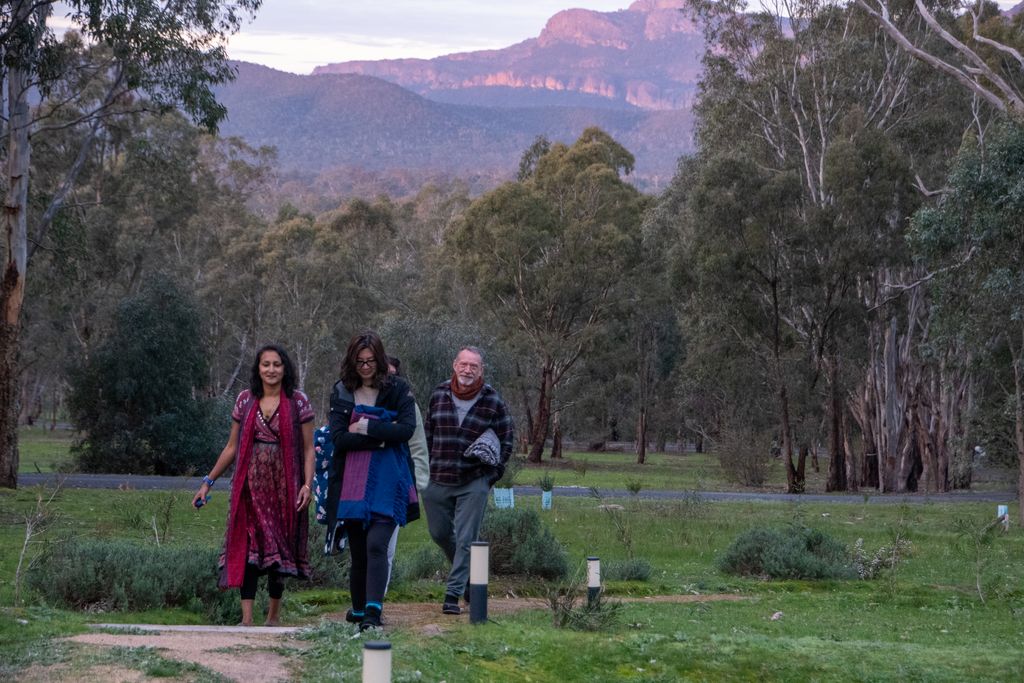
Today’s Meditation Musing comes after an overzealous bout of exercise has left me with two sprained knees.
After hobbling around for a week, my consciousness has been absorbed in what can normally go unnoticed – the act of walking, so bear with me as my mind meanders through!
The roots of the word ‘step’ lay in the Proto-Indo-European language, the mother tongue that gave rise to both latin and Sanskrit, steb: post, stem, or support.
What are the supports to the body?
Those great pillars we call ‘legs.’
For the brain, stepping has an interesting hemispheric pattern; the left brain controls the right side of the body, and vice-versa. When we walk, when we step, we engage the brain and body; it is integral to our nature as primates evolved from hunter gatherers.
Walking heals.
From another vantage point, a step is a movement, and movement infers direction; a ‘from,’ and a ‘to.’
The journey from darkness to light, from death to immortality, as encapsulated so eloquently in the Asato Ma mantra, IS the spiritual journey – a journey we are all on.
Yoga is a path, an art, a science, a way of navigating this journey back home to the Soul.
And what is walking… with style?
A Dance…
As I sit here pondering how many morning I took for granted my ability to dance, I offer you this reflection on the Yogic Dance, the Nrtta.
I dance a dance of Lord Shiva, a pure dance called the Nrtta. It is an ancient Hatha-yogic dance, a dance in which ‘the step’ is of prime importance.
As an aspirant on the path, one who is learning ‘to dance’, we bring mindful; awareness to the placement, orientation and weight of the foot as we ‘step.’
Once the basics of a dance form are understood and embodied, the mind is free to dissolve, like any craftsperson who has gone beyond the basics. This gives us space to direct awareness .
In plain speak, when we are getting started, the subtlety and complexity of movement can be a head-f*!k – the mind grinds in slow gears we try to do-the-thing we have been show.
With continued practice, step by step, the body’s memory takes over. Eventually, our mind is free to go beyond the technical aspects of the activity – one can connect to the feeling rather than the doing.
As we feel, the mind goes quiet and the hidden relationships between the body parts are revealed.
Beneath the skin, after all, is a dense matrix of interconnected muscles, tendons, ligaments and tissue that enable even the simplest of movements.
The deliberate choice to move in a cultivated manner has a few profound effects.
Firstly, the absence of thought. The mind is notoriously bad at doing many things at once, so when a dance is done with mantra gently rolling in internal recitation, it goes quite; it draws us within.
Secondly, the right hemisphere, the side of our brain that broadens awareness, is stimulated by the application of mindfulness directed to the body. This builds an expanding awareness and prepares the dancer for meditation.
Thirdly, the hidden currents and flows of energy through the nervous system remove obstruction in the body and allow the vital force (prana) to circulate more freely, helping the dancer to feel alive and at peace.
With enough dancing, readiness for meditation builds, and there is a natural transition to parking one’s bum on the floor and gently withdrawing from the external world.
Here the dancer may continue with mantra, helping to steady the mind, or as is my personal preference, to surrender, to let go, and to simply abide in being.
As my Guru share’s, this sort of practice is an arrival AT meditation.
In that quiet, one’s intuition, internal guidance, and communion with the divine is given space to arise. This is a place that when touched restores and revitalises the individual, a place that is deeper and more profound than the words we use to describe it.
So! How does one learn to dance like Shiva?
Step by step… until all notion of ‘like’ becomes ‘as.’
To dance with aspiration of becoming is different than to dances as that.
Here, the philosophical enquiry of Jnana Yoga is useful. One’s mind must calmly rest on the ancient Vedantic knowledge ‘Aham Brahmasmi’ (I am the Absolute, the limitless being-consciousness-bliss.)
To do this with sincerity, and without inflating the ego, requires a sharp, discerning mind. To dance as that, where the dance is not to get anyone, not to achieve anything, to dance merely as an expression of one’s nature is both the goal and the means to yogic accomplishment.
As a soldier, I fought through life in many domains of my life.
As a Sadhaka (an aspirant) I am learning to dance.
–
If giving up the fight in favour of the dance sounds great, but you are utterly confused or perhaps a bit curious, the path of Traditional Yoga taught at Kailash Ashram will equip you with the means, knowledge and tools to cultivate ‘the dance.’ Over time, your dance will evolve and grow, and will help you realise your true, eternal nature as being beyond both mind and body.
On the Soul Retreat we introduce the preliminary steps of the Nrtta, Shiva’s pure Dance, as taught to me in the Shadow Yoga school.
By the end of the retreat, you will have a basic sequence and will be ready to practice at home, beginning the journey of one thousand miles, with, you guessed it… a single step.
Click here to learn more about joining our Soul Retreat.
–
May your week be filled with mindful, pain free stepping!
Jai Atmeshwar
Victory to the Divine Soul
David